Shed Down!

This weekend is the fifth-and-a-bit anniversary of Shed Down at the allotment.

Sunday 2 February 2020

For a minute or so, I sat on the upturned water tank, sitting being something this fidget-arse does rarely. I glanced up at the new roof I’d just put on the shed, then down through the open door at the new floor I’d almost finished laying. A roof and a floor to replace rotten and sagging predecessors. I shivered with satisfaction; all I needed to do now was somehow strengthen the walls before the arrival of Storm Improbable Name.

Friday 7 February 2020

Although I made a couple more visits to the allotment during the week, I never did get round to reinforcing those walls. Oh well, too late now. With a full weekend’s worth of freelance work ahead, to the tightest of deadlines, it would be Monday before I’d be able to do anything about it.

Just before lunch, the allotment manager emailed all of us plotholders:

Hi all,

make sure your sheds etc. are secure – a storm is approaching

cheers

Monday 10 February 2020

Got the weekend’s work done but it took its toll. I couldn’t even muster a visit to the beloved allotment. In the evening, I got an email from the allotment manager:

Hi Joe,

I’m sorry to tell you but your shed blew down yesterday

cheers

I can’t say I was surprised but I did feel kind of upset when I saw the photos in the email. Guess I was more attached to this assembly of wood, screws and paving slabs than I realised. And now there it was, reduced to a scattered litter-jumble of wood panels and gardening paraphernalia.

Tuesday 11 February 2020

As I walked through Hanwell in the morning, the damage wreaked by the roaring windy blows of Storm Improbable Name (was it Dennis?) was still evident – garden fences, some over-leaning, some collapsed, and large branches part-obstructing the path on High Lane.

When I got to the allotment I found it strewn with debris all round – plastic bags, buckets and bits of wood everywhere. Ours appeared to be the only Shed Down, though as I approached it I could see that someone had transformed it into a wooden tent, with all the scattered contents collected up and placed neatly inside. It turned out B&B from the next plot along had very kindly made all safe.

Not ashamed to say there was a tear in the eye. Well, two. One for the thoughtfulness of our lovely plot neighbours, and one for the shed that was well and truly down as I stared at the incongruity of what was so familiar now distorted into all the wrong places.

And place is what it’s all about. The shed was the focus of the plot where we love spending time; weeding and sowing, chatting and watching wildlife. Then, there’s the shed itself, that we had built, maintained and repaired (but not very well, evidently).

Saturday 15 February 2020

At the allotment with my partner. We walked around the wooden tent pile that was once the shed and its innards, wondering where to start. ‘Let’s not buy a new one,’ she said. ‘Let’s rebuild this one.’

Sunday 16 February 2020

We wasted no time in planning the rebuild, and I swear to you I remember thinking that if Shed Down was to be the worst thing to happen this year, we should get it sorted as soon as we could.

Sketches were drawn, measurements taken, and gravel, sand and roofing bought. Excitement and hope kindled.

Friday 13 March 2020

Fulham v Brentford was called off. With the pandemic looming, we’d already decided not to go, even though we’d bought tickets. Too risky. It was starting to look like Shed Down wouldn’t be the worst thing to happen this year.

Friday 20 March 2020

My last day of travelling to an office. From now on I’d be working from home, if at all. As it turned out, allotments were allowed to remain open, so there’d be plenty of time to rebuild, and to discuss progress with neighbours from the socially distanced width of a raised bed.

A new feature – deep-sunk reinforcing posts

…and a host of golden tulips

Sunday 7 February 2021

Shed Up, one year after Shed Down

Notes from an allotment in May

SATURDAY 1 MAY

Reflecting robins composition

Spotted two robins together! Must locate their nest and keep well away from it. One year I accidentally disturbed one in the prunings pile. I felt miserable. I bet they weren’t too happy about it either.

MONDAY 3 MAY

I probably say this most months, but May really is one of the busiest of the year, when the things of spring step into summer. You get lost in the cycle of sowing, growing, weeding, netting and harvesting, all at once. And strimming. And pruning. Seemingly endless pruning of plum, greengage and damson trees. These trees are pruned in late spring because unlike the apple trees they can get a fungal disease if pruned in cold weather. It feels counter-intuitive pruning trees that already have fruit growing on them. How much to prune? The water shoots and maybe a bit more, but not too much. Some say, never shop when hungry. I say, never chop when angry.

The one that got away

Today I’m on the ladder, sawing a big branch up in one of the greengage trees. One large branch gets lopped from each tree, every year, to stop them getting too big. The trick is to start sawing from below, so that a great sliver of wood and bark doesn’t tear off at the end. A trick I rarely manage.

From my perch I see big bumbles hovering among the blossoms of apple, crab apple and sour cherry.

THURSDAY 6 MAY

Sowing is now in full swing. No matter how straight you sow the row, the seeds will move in the soil, for the result is always a meandering line of seedlings. My Special Theory of Seed Dislocation describes the various forces at work here: bent gravity, the motion of heavenly bodies, dark matter of course, soil rheology, little beasties like worms and earwigs, subsoil water flow, and last but not least, weeds. I suspect that young weeds move under cover of darkness, nudging the sown seed out of line and taking its place. All this to fool the gardener into removing the sown seedling instead of the weedling. As any fule kno, if it’s easy to remove the weed, it’s probably not a weed.

Fat Hen weedling among parsnip seedlings

SUNDAY 9 MAY

Slugs certainly know the difference between a seedling and a weedling. Slugs are The Enemy, but I can’t bring myself to kill them, at least not directly. Yoghurt pots sunk into the soil and filled with beer attract slugs that then fall in and drown, but what a way to go. We stopped doing it in the end, after a few days it smells revolting. So now we just throw them over the fence. To be fair, they too have their place in the cycle of life and decay: they help break down all vegetation (not just prized seedlings); and they are food to slow worms, toads, frogs and birds.

THURSDAY 13 MAY

In the greenhouse, and more sowing. There’s no wind, not even a breeze. So there’s no flap-flapping of plastic sheeting, just the dipple-dipple-dipple of light rain on the roof of my translucent tent.

FRIDAY 14 MAY

I spotted movement in the tree above the hedge. I could see it was a bird, but not what sort. What a wonderful song it had. Loud, cheerful, yet complex. A song thrush perhaps? In a short while it revealed itself to be… a blackcap.

SUNDAY 16 MAY

The weather has been changeable. Lukewarm rain one minute, sunny sun the next, and sometimes somehow the two at once. Rainbow weather. Weird weather. A day of dramatic cloud scapes and blowy rainstorms is followed by one of calm still sunshine. And repeat. That’s the British weather.

MONDAY 17 MAY

The rain has abated and the grass is just about dry enough for strimming. Cutting wet grass is a messy business and damages the paths and orchard ground. In summer it’s a task that never ends but I really enjoy it. Which is just as well because what I like to call the orchard hay meadow needs to be mown before the first of the plums and greengages fall. Still unripe, they make a lovely sharp windfall pickle.

Strimming’s a mildly OCD affair. I mentally define areas to be quartered in sequence. Most areas will have straight borders, following raised beds, for example. Others will be like mid-western states – three straight sides and a wobbly one that follows a natural feature, such as the wildlife hedge (aka the rubbish pile).

So much fun to be had in the United States of Strimming, but don’t get too distracted. Three days ago these irises were sheathed in green, camouflaged in the asparagus bed. Today their beauty nearly caused me to mow them down.

TUESDAY 18 MAY

This morning I weeded in bursts between showers while keeping an eye on the enormous bank of gun-grey dark cloud in the south, as wide as the sky. When it rained I sat in the shed and watched as the dark storm rumbled with thunder and spat flashes of lightning, while sliding slowly eastwards. The dirty-grey colour of the thundercloud went well against the green of the trees above which it hung.

It was exciting viewing the edge of the storm mass when the sky directly above me was a cosy cloudless blue. Cosy enough for me to start walking home. And get caught in a torrential downpour…

SUNDAY 23 MAY

All of a sudden the big planters in our Local Traffic Network (LTN21) have gone. Put in by the council under cover of Covid about a year ago, now lifted out by cranes like they were weeds. Wouldn’t mind a couple of them on the allotment.

THURSDAY 27 MAY

Work has kept me away from the allotment, bar a few fleeting visits. A lovely sunny day. Chive flowers dancing under the weight of bees upon them. Graham says the air smelt of summer last night. And Graham has a very good sense of smell.

They made a bee-line for the chives

The sunny spell continues and the bird song seems more abundant and vigorous as the days lengthen. May is the peak time for the dawn chorus and maybe next year I’ll try to get to the allotment before sunrise once or twice for a couple of early morning performances.

Thinning out the seedlings has risen to the top of the to-do list. It’s one of the more fiddly jobs and always feels like chucking the weakest chick out of the nest, even if thinnings are great in soups and salads. This year I tried practising a more socially distanced approach to sowing to reduce fiddly thinning syndrome.

SUNDAY 30 MAY

Yesterday, Brendan accidentally disturbed a robin’s nest among the bins at the back of his plot. Six little eggs abandoned and the parents never came back.

Rumtopf, Pontack and Nelson’s Blood

Grow your own booze

The Last of the Summer Wine – old demijohns in the garden

Years ago, the only booze we grew was home-made wine, using just about any fruit or vegetable growing, or going, on our allotment. I even made rose petal wine as a kid. You need a lot of petals. Once I’d removed every petal from the bushes in our garden (no one seemed to mind) I started on the neighbours’. Of course, I asked permission (most of the time). It was perhaps the only wine I ever made that didn’t give a hangover the size of Hanover and out of all proportion to the enjoyment of the sip. Even my mum liked it.

There are plenty of recipes online and in books. And you’ll find nearly all the gear you need in your local Wilko.

We no longer make wine as such – we now have other ways of growing our own booze. Here’s a brief A–Z (or A–S to be precise) of them.

Apples

We’ve made cider a few times, but usually find that apple juice fresh out of the screw press tastes too divine to do anything else with. So, the only contribution of the apple to our festivities these days is as an ingredient in rumtopf (see Rumtopf below).

Crab apples

Crab apples on the allotment

A Swedish recipe in which 20 or so crab apples are washed, halved then steeped in a jar of vodka for a few months in a dark place, turning and shaking from time to time. You can make it with or without sugar – we usually do one of each. After two weeks (with sugar) or two months (without) you strain off and bottle the infused vodka. The remaining vodka-steeped fruit makes a lovely jelly-jam. This year we’re trying it with gin.

Cucumbers

A fellow plot holder introduced us to the joys of cucumber in gin. The cucumbers we grow are sweeter and crunchier than shop-bought ones and have a slight lemony taste. The perfect snack once your glass is empty!

Damsons

Damson gin is lovely. Don’t bother removing the stone-pips; too fiddly. Just pick, rinse, prick and pickle in gin – not easy to say after a damson gin or two. Add half as much sugar as you have fruit, cover and leave for three months. After the damson gin has been decanted off, the gin-soaked fruit makes a delicious damson gin jam, which isn’t that easy to say either. It also makes a super sauce.

Elder

Elderflowers scent cordials. Elderberries are chock-full of vitamins and make great syrup. Both are popular with wine-makers. I came across this recipe for Pontack Sauce in Richard Mabey’s Food for Free. It’s not really booze but it is interesting. Pontack Sauce was once a must in the luggage of every retired military gentleman when travelling.

Take a deep breath and: pour one pint of boiling claret over a pint of elderberries in a stone jar. Cover and stand overnight in an oven on a very low heat. The next day, pour off the liquid into a saucepan with a teaspoon of salt, a blade of mace, 40 peppercorns, 12 cloves, a finely chopped onion, some ginger, and a partridge in a pear tree. Boil for ten minutes, bottle and – here’s the best bit – leave for seven years. Seven years? A recipe too far, methinks.

Greengages

These go well in rumptopf, along with apples and any other fruit that takes your fancy. What is rumtopf, apart from being a lovely word? (see Rumtopf below)

Hops

One of our plot neighbours grows hops, supported by pieces of string hung from a large wooden frame, in a runner bean style. The hops are used to make craft beer. Haven’t tried it, but I’m told craft beer slops make good fertiliser.

Marrows

Marrow rum is an interesting concept that we’ve yet to try as it seems a bit laborious. In short it involves cutting the top off a marrow, scooping out the seeds and filling with demerara sugar and a yeast preparation. You fix the marrow top back on and when the marrow starts to drip, drain into a demijohn and add raisins. Fit an airlock and let it ferment, then bottle and leave for a year or so. Hmm, might give it a go.

You can find the complete recipe here: Marrow Rum Recipe – How to Make Marrow Rum (lowcostliving.co.uk)

Wasps don’t talk about love – they only wanna get drunk

Plums

These don’t tend to finish up in the booze production channel. But each autumn we do notice wasps getting plastered on the rotting windfalls.

Potatoes

It’s illegal to make potato vodka at home but you can find dozens of ‘hypothetical walk-through’ recipes online.

Rosehips

The only home-made wine we stuck with after abandoning all others. Sweet and sherry-like, and not too headachy. These days we either do rosehip syrup (more vitamins than oranges) or rosehip sauce (great with pork).

Get back in the dark cupboard!

Rumtopf

Friends in Southport introduced us to this delight. Use just about any fruit you fancy; dried, frozen or fresh. We go with greengages, apples and sultanas. Chop larger fruit into bite-sized pieces, and mix with the remaining fruit. Add half the amount of sugar and leave for an hour. Put in a pot, add rum and leave in a dark cupboard for two or three months. Add more rum if needed.

Sloes

Sloe gin. As for Damson gin above. After the sloe gin has been decanted off, you can use the gin-soaked fruit to make Nelson’s Blood. Pour ruby port on the fruit to fill the jar, seal and leave for three months.

Nelson, from the Kellogg’s 1966 Heads of Fame series, assembled by me after breakfast, aged eight

Sour cherries

If any are spared by wild animals, or by us (great with ice-cream and shaved dark chocolate), cherry whisky is the way to go. Stone a pound of sour cherries (I guess ordinary ones would do just as well), chop up the flesh and crush the stones. Add to a big jar, along with half a nutmeg, a blade of mace, a few peppercorns and a tablespoon of sugar. Fill to the top with whisky and put a lid on it. Two weeks later you’d be saying ‘What a winter warmer!’ if it weren’t such a cliché.

Map traps and Mountweazels

Trap streets, phantom settlements and fictitious book entries

Rainy childhood afternoons found me gazing at Ordnance Survey maps, giddily tracing paths across pale brown contour lines that were dramatically close-bunched for hills and gorges, or meandering far apart in wide, gentle valleys.

Nowadays I join fellow cartophiles online, where I recently went down a rabbit hole only to discover that some roads and places on maps aren’t real, but fictitious, inserted deliberately. I was stopped in my tracks. Then my still childlike imagination swung into action. If it’s on a map, it must be real. So where are these places? Who lives there? Are they portals to parallel universes? Perhaps, for I’ve since discovered several stories featuring trap streets or phantom settlements.

In the Doctor Who episode ‘Face the Raven’, alien refugees hide in a London alley invisible to passers-by. Anyone noticing it on a map would assume it’s a trap street. The Doctor saves the refugees by searching for trap streets on a street map.

Truth is, map publishers include fictitious streets to discourage and prove copyright infringement. In 2005, the Geographers’ A-Z Map Company claimed there are “about 100” trap streets in the London A-Z Street atlas.

One phantom settlement even became real. Agloe was a fictional trap hamlet marked at a road junction on a map of New York State. In the 1950s, a shop was built there, named Agloe General Store because ‘Agloe’ is the word the builders saw marked on the map.

Copyright infringement prosecutions rarely succeed. Even if a map is eligible for copyright, courts usually decide that fictitious entries aren’t. Prosecutions are more successful when the map maker changes the depiction of an existing street instead. In 2001, the Automobile Association settled out of court for £20 million after copying Ordnance Survey maps. No fictitious entries were involved, the Ordnance Survey protected its copyright by using specific style features such as varying road widths.

Not using trap streets on maps also avoids the risk of interfering with road users’ navigation and sending them down non-existent roads and perhaps even into other dimensions.

Fictitious entries also occur in reference books, which often contain fake entries either as humorous hoaxes or to deter plagiarism. Again, legal action rarely succeeds. The Trivia Encyclopedia deliberately included false information about TV detective Columbo and then unsuccessfully sued Trivial Pursuit, who had copied it.

Fake entries in books are often called ‘mountweazels’ after Lillian Virginia Mountweazel, herself a fake entry in the 1975 edition of the New Columbia Encyclopedia. The entry stated that she was born in 1942, photographed unusual subjects such as New York City buses, Paris cemeteries and rural American mailboxes, and died aged 31 in an explosion while on assignment for Combustibles magazine. She even has a Facebook page.

Probably the most well-known fake entries in serious reference works are:

  • Zzxjoanw: a Maori drum. Rumbled because Maori does not use J, X or Z.
  • Jungftak: a Persian bird – the male has just one wing, on the right, and the female one on the left. Too far-fetched, even for me.
  • Esquivalience: wilful avoidance of one’s official responsibilities. Certain politicians spring to mind – I’ll be keeping an eye out for this one.

This article was originally posted in 2021 in the blog section of the website run by my colleagues at Accuracy Matters: Accuracy Matters | Home

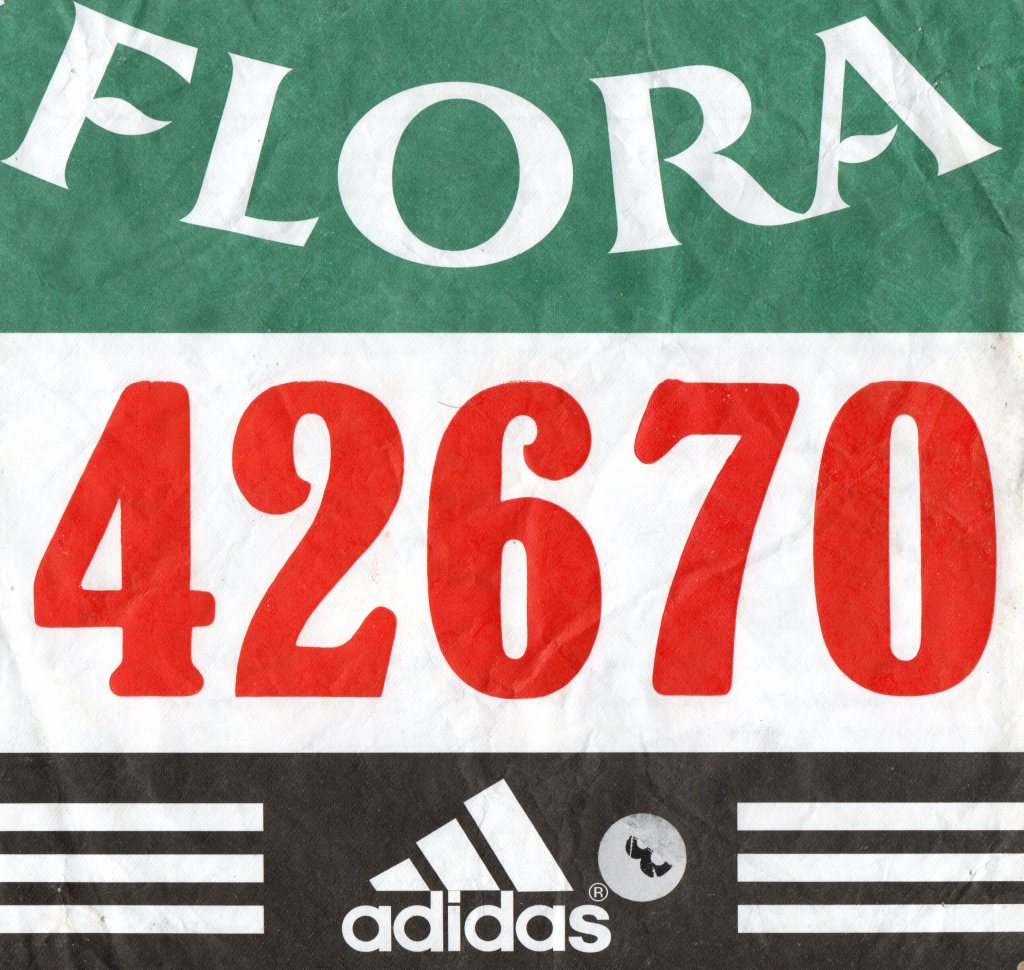
My first London Marathon

Do you notice more runners on the nation’s streets from January to April? It’s likely they’re training for the London Marathon, which usually takes place towards the end of April. You are witnessing them meld into athletes, just as winter melts into spring. Most of them have got 16 weeks of this, with just a couple of days off a week. Here’s how it went for me…

THE STARTING LINE: Wow! A place in the 2006 London Marathon running for the NSPCC! A place at last, at the grand old age of 48! Elation soon dissolves into knee-wobbliness as I think of what lies ahead. In the next few months I learn that the training is a marathon in itself.

1: You don’t need any equipment to go running, just a good pair of trainers.

2: And some padded socks, blister plasters, support bandages, lycra shorts, over shorts, tracksuit bottoms, nipple plasters (hard to get off a hairy chest), breathable mesh tops, lightweight waterproof jackets, beanie hat, gloves, sports watch (with GPS and computer), sports drinks, sports snacks, glucose gels, jelly babies, heart-rate monitor, mobile phone holder, fancy water bottle, fancy strap thing to stop glasses falling off, iPod (best investment of the lot), radox, vaseline, deep freeze pain spray… Of course, I didn’t bother with a lot of this stuff.

3: Finding the right trainers is a big issue. At the specialist shop Run and Become in London’s Victoria you have to run down the street to test each pair you try on. Each time I do so I’m accosted by a guy selling magazines. “Big Issue, sir?” he says, smiling, as I jog by. While trying out the third pair I relent and buy a copy; it is a fundraising event after all.

4: My training plan is the beginners’ ‘just about gets you round’ schedule from my copy of Running Is Easy (no it jolly well isn’t). I realise I’m not even up to that, so I plan some pre-training training in the run-up to Christmas. My goal is simply to complete the course without stopping, without walking. I don’t have a specific time in mind but within five hours would be nice.

5: Pretty soon I realise that it’s not just about getting fit and building stamina; it’s about building mental strength, too. You end up talking about it quite a lot. The NSPCC is very supportive with emails and newsletters – they don’t want their jogging investments letting them down.

6: Sticking to the schedule isn’t easy and I expect/hope to come down with one of my usual heavy winter colds at any time. Sometimes I laugh when the schedule stipulates medium-pace, or fast. I’ve only got one speed mate, and it’s neither of those!

7: The organised training races are fun though: warm-up stretches at Eastbourne in a freezing gale; super-friendly Crumlin in Wales; the inspiring finish in a packed Madejski Stadium in Reading.

Halfway round the Reading Half

8: Sometimes it hurts: nipple rash, sore ankles, stiff joints and stomach cramp. The time I half-loped, half-skipped home like a child pretending to be a horse.

9: Laura (coach and sister) makes sure I do the training. Her 5.30am alarm text messages keep me on track.

10: As do the tracks on my iPod; I air-drum and sing as I run. Passers-by stare at the mock water station Laura sets up in the local park to get me used to drinking while running.

11: With two weeks to go it’s starting to come together: the training; the mental attitude; the sports massages; cross-training at the gym; soaking baths; resting; proper diet…

12: ‘Nothing tastes as good as slim feels’ I tell myself day after day over yet more porridge, bananas and pasta.

13: I collect my vest and number at ExCeL and start to think about the big day: how to avoid the need for loo stops; the mantras I’ll be repeating to myself, ‘strong, determined, focused’, that kind of thing. For once, there’ll be no iPod pumping punk classics to help me along, just the sound of the crowd.

14: I’ve pledged to raise at least £1,500 for the NSPCC and I meet the target with a welcome last minute flurry of sponsors at my JustGiving site. Fundraising is easier than I thought it would be. People are surprised into giving money to a lazy-arse like me .

15: The night before the race is all calm preparation: ironing my name on the shirt, packing, searching out safety pins for my race number, puzzling over the timing chip, good luck text messages from friends and relatives.

16: The big day arrives and what a day! We get up early to travel to Greenwich on packed trains, then crowds of us shuffle to the start. I do my warm ups while waiting in the queue for the toilets.

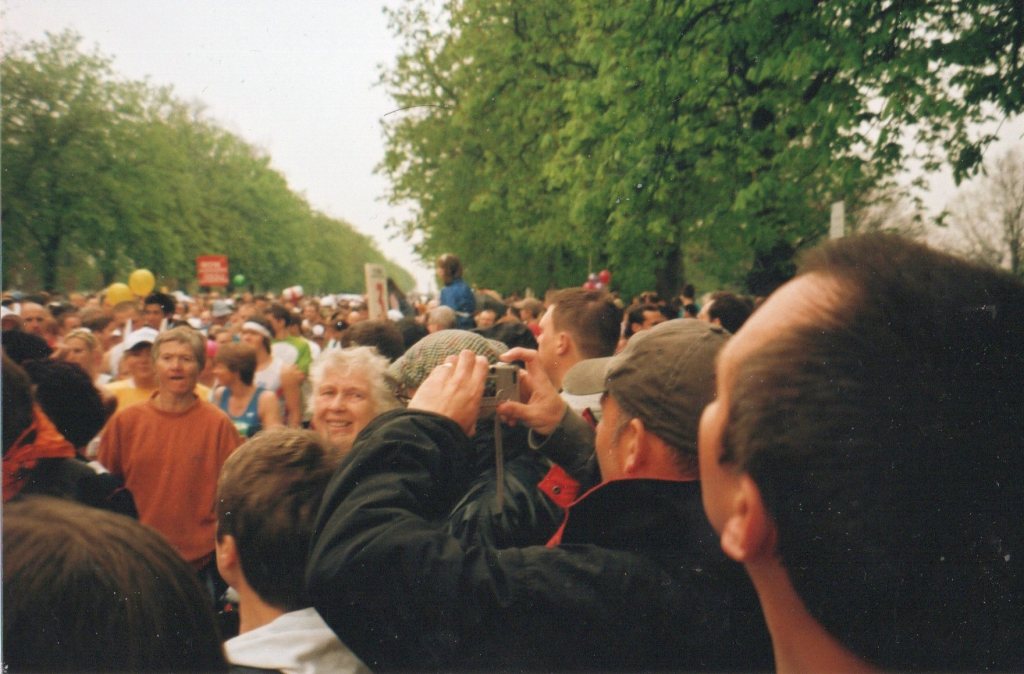
17: The start of the race is chaotic and crowded, the atmosphere friendly and expectant.

18: I really enjoy the first 18 miles: thousands of spectators smiling, waving and cheering as I settle into a good running rhythm. Some of them goading from pub doors, as they slurp mid-morning pints. Some of them offering handfuls of dolly mixtures and jelly babies; but I still never accept sweets from strangers…

19: In Wapping, the fun and excitement turn to pain in the rain. I see some friendly faces and give sister Laura a hug while running on the spot.

20: Somehow I keep going through the agony of the last few miles, urged on by cheering crowds. A well-dressed man, slightly the worse for wear, hurls abuse at us: “Bah! It’s jusht masses for the classes!” I think I know what he means.

21: The NSPCC said to raise your arms as you cross the line. I honestly thought I had. Elation and relief mix with pain and nausea. I feel great. I can hardly walk.

22: My time is 4 hours, 52 minutes and 41 seconds. No stopping, no walking.

23: I finish 24,212th out of 32,983.

24: I raise £1,746 for the NSPCC.

25: I’ve had not even a sniffle in four months of training in the cold and wet.

26: FINISHING LINE: Not one cold all winter. Something of an achievement, that.

So here’s to all you joggers, who go round and round and round.